The Language Passport
A language journey you can hold.
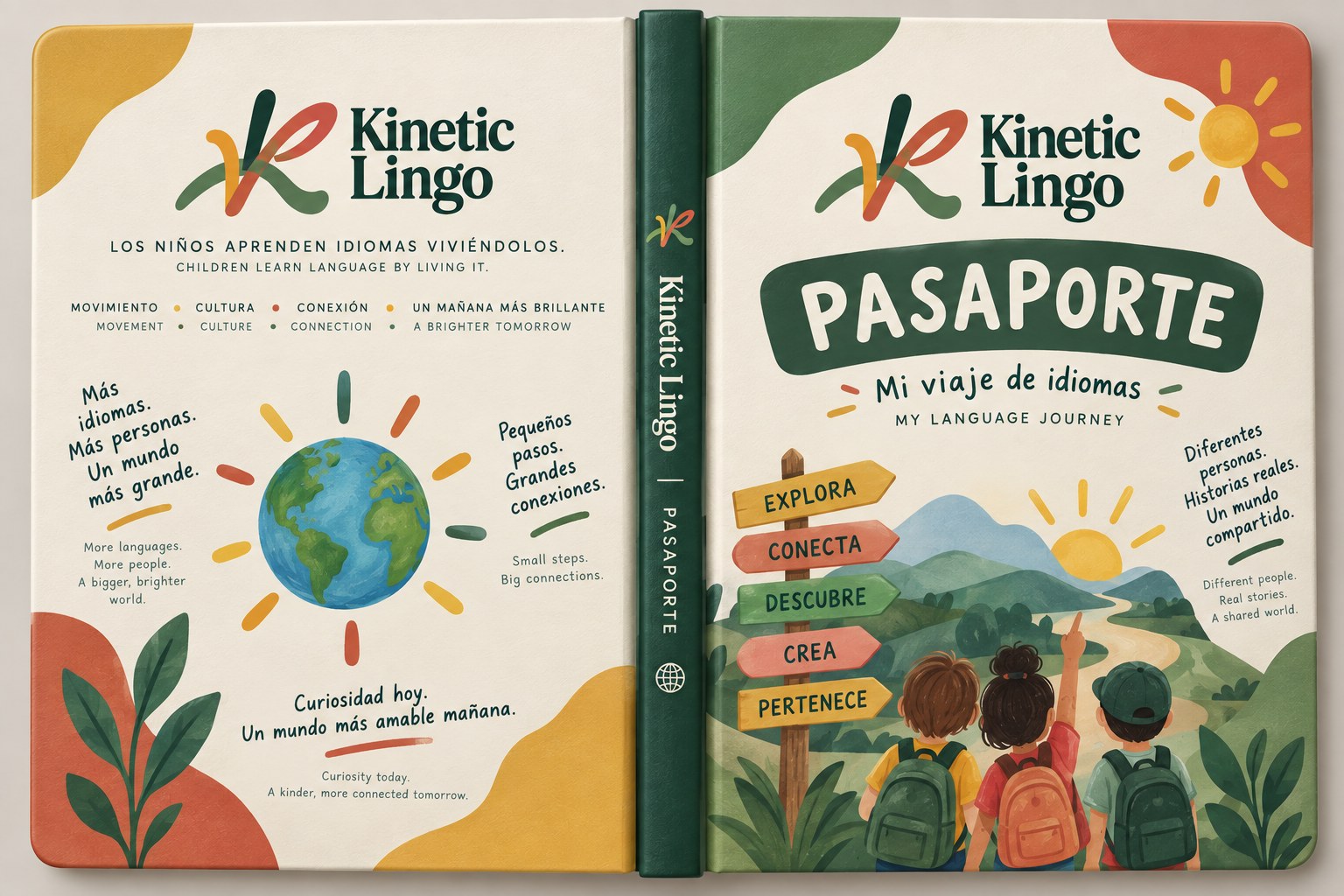
The Kinetic Lingo Language Passport is an optional physical companion to your child's Spanish experience.
As children explore, communicate, make choices, and connect, the Passport gives them a tangible place to carry traces of those experiences forward.
- Optional
- Physical
- Personal
Why a physical passport?
Some experiences are worth carrying with you.
Kinetic Lingo begins with what happens in the experience itself: moving with meaning, communicating with another person, exploring a cultural context, making a choice, discovering something new.
The Language Passport creates a physical connection to those moments.
Rather than becoming another workbook to complete, it gives children space to leave traces of the experiences that mattered to them — and to revisit those traces as their relationship with Spanish grows.
The experience comes first. The Passport helps make the journey visible.
Experience first
Live it first. Then leave a trace.
The Passport follows a simple rhythm:
- Experience
- Notice
- Capture
- Revisit
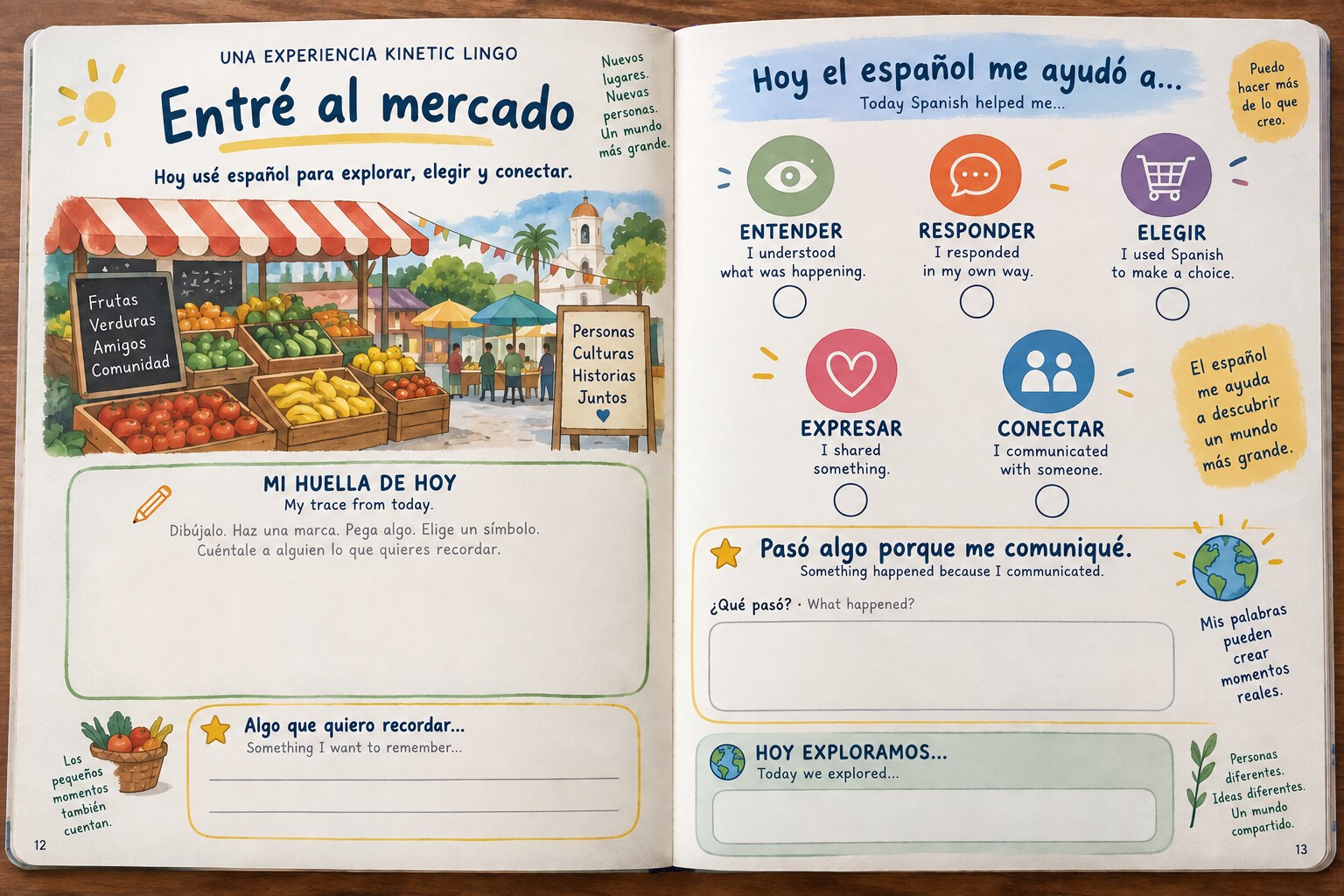
A child might participate in an imagined market, follow Spanish to find something, make a choice, communicate with another person, or discover something about how Spanish lives in the world.
Afterward, the child can choose how or whether to leave a trace of that experience in the Passport.
That trace might be a drawing, a mark, a word, a symbol, a small paper artifact, or something shared with an instructor.
There is no single right way to fill a Passport.
What Spanish helped me do
Progress is more than a list of words.
The Passport is designed to recognize what children are increasingly able to do with Spanish, not simply which vocabulary words they have encountered.
Over time, experiences can create opportunities for children to make meaning, respond in their own way, make choices, express something, connect with another person, explore language in cultural context, and carry what they know into new moments.
A child does not need to demonstrate all of these things at once.
Different experiences reveal different parts of a child's growing relationship with Spanish.
Multiple ways in
A language journey doesn't have to look the same for every child.
One child may speak. Another may point, gesture, move, draw, choose an object, respond with a partner, or spend time observing before joining in.
The Passport is designed with that learner variability in mind.
Children can leave traces of their experiences in different ways, and participation is not reduced to who speaks first, speaks most, or performs publicly.
- Say it
- Point
- Move
- Draw
- Choose
- Watch
- Join
Participation comes before performance.
Communication that matters
Language can change what happens next.
Some of the most meaningful moments in language learning happen when communication has a real consequence.
A child makes a choice and receives what they selected. A question leads to an answer. A request changes what happens. A peer responds. An instructor understands.
The Passport can help children notice moments like these because communication becomes especially meaningful when children experience that what they say, show, choose, or express can matter to another person.
Pasó algo porque me comuniqué.
Something happened because I communicated.
Culture as context, not costume
The journey is also about people and places.
Spanish belongs to many communities, places, histories, and ways of life.
As Kinetic Lingo experiences introduce children to cultural contexts, the Passport can provide a place to remember what they encountered, wondered about, compared, or discovered.
The goal isn't to collect cultural trivia or reduce Spanish-speaking communities to flags, foods, or festivals.
It is to help children gradually discover that learning another language can also open new ways of understanding and connecting with people and the world.
Language lives in human context.
For children — and for families
Something your child can bring home.
The Language Passport belongs first to the child, but it can also give families a window into experiences they didn't see firsthand.
Instead of only asking, “What Spanish words did you learn today?” a parent might open the Passport and ask:
Show me what happened.
A drawing, mark, instructor note, remembered interaction, or small artifact can become the beginning of that conversation.
The Passport is not intended to provide a comprehensive assessment of a child's Spanish. It is a tangible record of experiences, discoveries, and moments of communication along the way.
Purposeful by design
A companion, not a scorecard.
The Passport can be
- A record of experiences
- A place for children's traces
- A way to notice meaningful communication
- A window into the experience for families
- A keepsake that grows over time
- A companion to Kinetic Lingo
The Passport is not
- A vocabulary checklist
- A workbook
- A test
- A report card
- A reward or points system
- A formal proficiency certification
Optional by design
The experience stands on its own.
Children do not need a Language Passport to participate fully in Kinetic Lingo.
Classes are designed to be complete experiences on their own. The Passport is an optional, highly recommended way to extend those experiences, create continuity between them, and give children something tangible to carry forward.
The Passport supports the experience. It doesn't define it.
Ready to experience Spanish differently?
Kinetic Lingo currently offers Spanish experiences for individual learners and privately organized groups in the San Francisco Bay Area.